PRP Treatment for Hair in Berlin
The body’s own growth factors to support the hair roots. Treating the scalp is the focus of our practice on Kurfürstendamm.
Thinning hair affects men and women alike, and it often affects them sooner than they would like. PRP starts where active hair roots are still present and uses the growth factors from your own blood to support these roots.
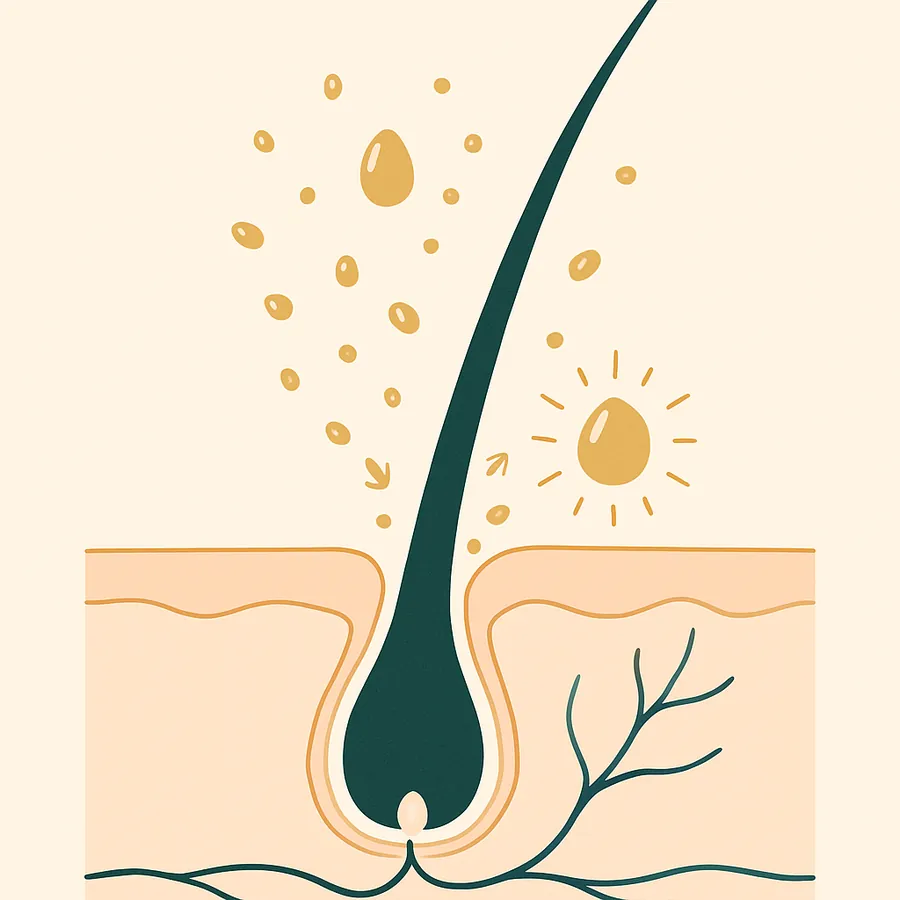
How PRP is intended to work at the hair root
Every hair grows from a follicle that is supplied by fine blood vessels. In PRP treatment, the prepared plasma is introduced specifically into the scalp, where the follicles sit. The growth factors it contains are intended to stimulate circulation and support the supply of the hair roots. The prerequisite is that the follicles are still active.
Blood plasma contains a whole bundle of such messenger substances. Among others, the specialist literature describes platelet-derived growth factor (PDGF), transforming growth factor (TGF) and vascular endothelial growth factor (VEGF). VEGF is attributed an important role in the formation of new blood vessels around the hair root, that is, the blood supply during the active growth phase. For the cells of the dermal papilla, the control centre at the base of the follicle, a stimulating effect has been described in studies. Also under discussion are a faster transition from the resting phase to the growth phase and a thickening of existing hair shafts.
Medication stops, PRP builds up
Medication and regenerative therapy are not opponents; they work on different levels. Finasteride and dutasteride reliably stop hereditary hair loss, but they do not trigger new growth. That is exactly the task of PRP: to bring the remaining hair roots back into the growth phase. This is why PRP is the natural answer to hair loss — it works exclusively with the body’s own components. And because nothing foreign to the body is used, the treatment is virtually free of side effects; a reaction at the injection site remains possible, as with any injection.
Anyone who does not want to or must not take medication is treated with PRP alone. Those who do take it can usually manage with longer intervals between sessions, because the hair loss is slowed by the medication. Both paths are viable; which one suits you is something we clarify in the consultation.
| Feature | Finasteride, dutasteride | Minoxidil | PRP |
|---|---|---|---|
| Task | stops hair loss | promotes circulation and growth | promotes growth, reactivates dormant follicles |
| Works for | hereditary hair loss | hereditary hair loss | all forms, as long as hair roots are present |
| Use | permanent, daily | permanent, daily | sessions, then maintenance |
| Body’s own | no | no | yes, exclusively |
If you have been using minoxidil for years, you should not stop without consulting us first. The reactions that can occur after a session are described under Risks and limitations.
For men and women
The most common form of hair loss is hereditary. In men it often shows as a receding hairline and a thinning crown, in women more as general thinning along the parting. PRP can be considered for both patterns, as long as hair roots capable of regeneration are still present. There are also forms of diffuse hair loss for which support can likewise make sense.
What the research shows
PRP for hereditary hair loss is the subject of numerous studies. Recent reviews suggest that PRP can support hair density, but at the same time point to the inconsistent quality of the studies and the different preparation methods. A blanket guarantee of success cannot be derived from this, but its classification as a serious treatment option for suitable cases can.
The combination with established treatments is worth a look. In several studies, PRP was given in addition to an existing therapy with minoxidil or finasteride. There, improvements compared with the baseline were seen in hair count, hair density and the proportion of hairs in the growth phase. In such concepts, PRP is therefore seen less as a replacement and more as a building block that can complement existing measures. What makes sense in your case is something we assess together.
The hair grows actively, often for several years.
Growth stops and the follicle retracts.
The hair rests and falls out while a new one forms.
PRP aims to support the growth phase. Because the cycle takes time, results only become visible after months.
The hair cycle also explains why patience is needed. The growth phase (anagen) lasts roughly two to seven years depending on the person, the short transition phase (catagen) two to three weeks, the resting phase (telogen) around three months. A treatment cannot skip this rhythm, only support it. This is why a result unfolds over several cycles and not from one week to the next.
The procedure at our practice
- Detailed consultation and examination of the scalp
- Blood draw and preparation of the plasma according to the Azar Protocol
- Targeted introduction into the affected areas of the scalp
- An appointment usually takes about 45 to 60 minutes, after which you can immediately return to your daily routine
The treatment rhythm
PRP does not work through a single session, but through a coordinated series. A staggered rhythm has become established in the scientific literature: first several sessions at shorter intervals to set a basic stimulus, then longer intervals and finally maintenance with a few top-ups per year. This structure takes into account that the hair cycle needs time and that the gain achieved needs to be maintained. We set your specific plan after the initial examination, adapted to your starting point and progress.
Treat first, then decide: PRP before a hair transplant
A hair transplant redistributes your own hair: follicles from the hair fringe are moved to where nothing grows any more. It does not stop the hair loss itself. Anyone who has a transplant too early therefore often experiences the same thing — the hair loss progresses in the untreated areas, and later there is no donor hair left for a second procedure. The hair fringe is a limited resource; every harvest uses some of it up.
This is why we keep to this order:
- Treat the hair loss first. PRP reactivates the existing hair roots, accompanied by medication if needed.
- Then see what your own hair can achieve again. Thinning areas often become smaller on their own, because dormant follicles form hair again.
- A transplant only if it is still needed then. It requires fewer grafts, spares the hair fringe and sits in a stable setting of strong natural hair.
In many cases, this makes the procedure smaller. In some, it becomes unnecessary altogether. Both are a good outcome — which of the two applies only becomes clear after the basic therapy.
PRP and hair transplantation compared
The two procedures are often played off against each other, yet they pursue different goals and frequently complement each other.
| Feature | PRP | Hair transplant |
|---|---|---|
| Approach | support existing hair roots | redistribute hair roots |
| Suitable for | active follicles that are still present | areas that are already bald |
| Procedure | injection, outpatient | surgical procedure |
| Result | gradual over months | permanent at the transplanted site |
In many cases, a combination makes sense. Which path suits you is something we clarify individually.
After the treatment
PRP is considered compatible with everyday life. To support the result as well as possible, we give you a few simple tips:
- On the day of treatment, do not rub the scalp hard and avoid intense heat such as a sauna.
- Slight redness or a feeling of tightness can occur and usually subsides quickly.
- It is best to avoid sport and direct sun on the first day.
- Attend the next sessions according to the agreed plan, as the effect builds up over the series.
Before and after: view documented results from our practice
Read more: What is PRP? · Costs and treatment plans · View results
Frequently asked questions about PRP for hair
Who is PRP for hair loss suitable for?
PRP is mainly considered for hereditary hair loss (androgenetic alopecia) at an earlier stage and for diffuse hair loss, as long as active hair roots are present. Whether the treatment makes sense in your case is something we assess honestly in the consultation.
How many sessions are needed?
An initial series of several sessions a few weeks apart is usual, followed by top-up sessions. We draw up your individual plan after the initial examination.
When will I see the first results?
Hair cycles take time. First changes typically show after about three months, a more complete picture after six to twelve months.
Can PRP replace a hair transplant?
PRP and hair transplantation pursue different goals. PRP aims to support existing hair roots. Where hair roots have already been lost, only a transplant can bring hair to the area concerned. Both procedures can be combined in an overall concept.
Sources
Scientific sources for context. This article is for general information and does not replace medical advice.
Personal consultation on Kurfürstendamm
Whether PRP is right for you is something we clarify in a personal consultation. No obligation, honest and straightforward.