What is PRP?
Platelet-rich plasma, PRP for short, is a concentrate made from your own blood. This article explains neutrally what lies behind it and what the procedure is based on.
Behind the abbreviation PRP lies a simple basic idea: the blood contains components that the body uses for healing and tissue regeneration. PRP makes use of exactly these components by concentrating them from a small amount of blood and delivering them precisely to where they are intended to act.
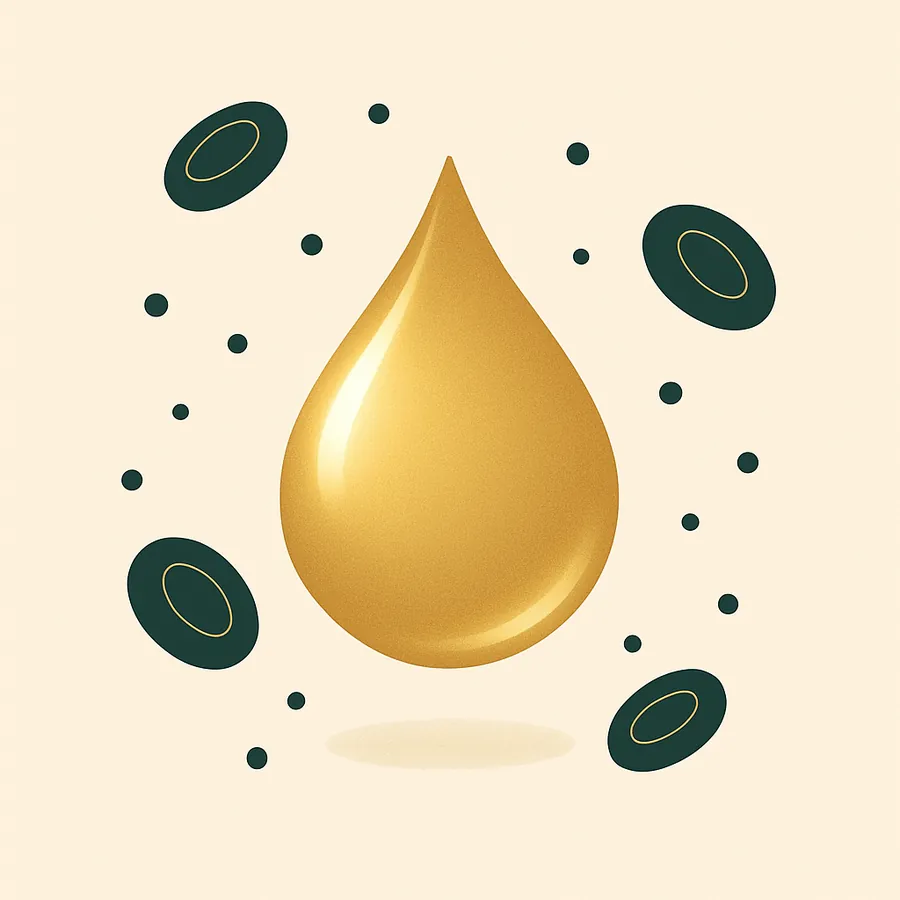
The components of blood
Blood consists of solid cells and liquid plasma. The solid components include red blood cells, white blood cells and the platelets, medically known as thrombocytes. In everyday terms, these platelets are known mainly for blood clotting. However, they also have a second task: inside them they store a large number of growth factors, that is, messenger substances that trigger repair processes in the tissue.
For PRP, the blood is prepared in such a way that the proportion of these platelets in the remaining plasma is significantly higher than in the original blood. The result is a golden-yellow liquid: the platelet-rich plasma.
In figures: in normal blood, the platelet count lies roughly between 150,000 and 400,000 per microlitre. A concentrate is considered platelet-rich when it reaches a multiple of this. The specialist literature often cites three to five times the baseline value; some systems reach four to eight times. This enrichment is the core of the procedure, because as the number of platelets rises, so does the quantity of growth factors.
How PRP is obtained
In most practices, the procedure follows a similar pattern:
- A small amount of blood is drawn from a vein in the arm, comparable to a routine check-up.
- The tube is placed in a centrifuge, which separates the blood into its components by spinning it rapidly.
- The platelet-rich plasma layer is removed and prepared for injection.
- The concentrate is then introduced into the target area, for example the scalp or the facial skin.
A small amount of blood from a vein in the arm, just like a routine check-up.
Rapid spinning separates the blood into its components.
The golden-yellow plasma is applied precisely to the treatment area.
What growth factors are intended to do
The idea behind PRP is to concentrate the body’s natural repair mechanisms at a specific site. The growth factors released send signals to the surrounding cells. Depending on the area of application, they are intended, for example, to stimulate blood circulation, support cell division or activate dormant structures. In the field of hair, the focus is on the hair follicles; in the field of skin, on the formation of collagen and general tissue regeneration.
A sober assessment is important: PRP is not a miracle cure and does not replace a fundamental medical investigation of the cause. The scientific evidence varies in robustness depending on the area of application and depends heavily on the preparation and on the selection of the people treated.
Not all PRP is the same
One point is often overlooked: PRP is not a uniformly standardised product. Depending on the preparation, the concentrates differ considerably, for example in the number of platelets, the content of white blood cells or the type of activation. Specialists therefore use several classification systems to describe these variants. In practice this means one thing above all: the chosen procedure influences the result, which is why the quality of the preparation matters more than the mere term PRP.
How it differs from related terms
Several terms circulate around PRP and are not always used with clear distinctions. Common ones are ACP and CGF, which stand for different preparation methods, as well as marketing terms such as vampire facelift. How these relate to each other is explained in the article on the difference between PRP, ACP and CGF.
Read more: PRP, ACP or CGF? · PRP for hair loss · Autologous blood therapy at a glance
Frequently asked questions about PRP
What does the abbreviation PRP stand for?
PRP stands for platelet-rich plasma. It refers to the portion of the blood plasma in which the platelets are present in concentrated form.
Is PRP the same as autologous blood therapy?
PRP is a form of autologous blood therapy. The umbrella term autologous blood therapy covers several procedures that work with the body’s own blood. PRP is the most widespread and best-studied variant today.
Who is allowed to perform a PRP treatment?
In Germany it is a medical procedure, as blood is drawn and injected again. The preparation and injection belong in the hands of a doctor.
Does a PRP treatment hurt?
The blood draw is the same as a normal blood test. The subsequent injections are usually described as well tolerated; on sensitive areas a numbing cream can be used.
Sources
Scientific sources for context. This article is for general information and does not replace medical advice.
Personal consultation on Kurfürstendamm
Whether PRP is right for you is something we clarify in a personal consultation. No obligation, honest and straightforward.